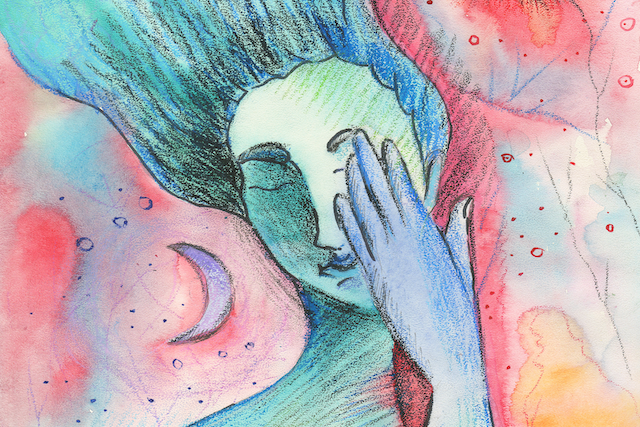
“Peace is not the absence of conflict, but the ability to cope with it.” ~Anonymous
My sister called four times before I picked up.
Not four times in one day—four times over three weeks. Each time, I watched her name light up my phone, felt something tighten in my chest, and set my phone face-down on the counter.
I told myself I was protecting my peace. I’d read that phrase everywhere that year. It was on water bottles, on Instagram infographics, on the lock screens of women I admired who seemed to have figured out something I hadn’t. Protect your peace. It sounded so clean. So justified.
What I didn’t tell myself was that I already knew what she was calling about.
Our dad had gone in for tests two months earlier. Nothing had been said definitively yet, but there was a texture to the silence in our family group chat that told me something was coming. And I did not want to be the one on the phone when it arrived.
So I didn’t answer. I told myself I was busy. I told myself I’d call her back when I had more emotional bandwidth. I told myself, genuinely believing it, that avoiding this call was a form of self-care.
It is astonishing, looking back, how completely I convinced myself that hiding was the same thing as healing.
I want to be honest about how far this went, because I think the small, unglamorous details are the only ones that actually mean anything.
I stopped opening texts from my sister and let them sit as unread, because an unread text still technically hadn’t been received, in the strange math I was doing in my head.
I told a close friend, when she asked how my dad was doing, “I’m trying not to think about it too much—I’m protecting my energy.” She nodded like that made complete sense, because it’s a sentence that’s supposed to make complete sense. It has the shape of wisdom. It just didn’t have any of the substance.
I went to yoga more that month than I had in the entire previous year. I meditated most mornings. I said no to a work project that would have been a stretch for me, telling myself I needed to conserve my resources. On paper, I looked like someone taking beautiful care of herself.
Underneath it, I was just a person standing very still with her eyes closed, hoping that if she didn’t move, the thing coming toward her might lose interest and go somewhere else.
The call came on a Thursday. I know it was a Thursday because I remember thinking, absurdly, that Thursdays felt like a strange day for news like this to arrive. News like this seemed like it should come on a weekend, when you at least had two days of nothing to fall apart in.
It wasn’t my sister who reached me first. It was my mother, and her voice had a flatness to it I’d never heard before, like she’d used up all the other tones already on someone else.
She told me the results had come back. She told me the word. She told me my sister had been trying to reach me for weeks because she didn’t want me to hear it like this, alone, from a voicemail.
I sat on my kitchen floor for a long time after that call ended. Not crying, actually. Just sitting, my back against the cabinet, doing an inventory of every unanswered call, replaying them one by one like some kind of confession.
I had thought I was protecting myself from pain. What I had actually done was make my sister carry the weight of trying to reach me, again and again, while she was scared too, while she needed someone on the other end just as much as I was avoiding being that person.
I called her back within the hour. She picked up before the first ring finished, which told me everything about how long she’d been waiting.
“I didn’t know how to tell you,” she said, and I could hear that she’d been crying, probably more than once, probably alone in places where no one had been checking on her either.
“I know,” I said. “I’m sorry. I should have picked up.”
There was a pause, and then she said something I’ve turned over in my mind more times than I can count since: “I kept thinking maybe you already knew somehow, and you just needed space. I didn’t want to push.”
She’d taken my avoidance and turned it into a kindness she was extending to me. She’d assumed my silence meant I was coping in my own way, when really it meant I’d left her to hold something enormous by herself because I didn’t want to feel it yet.
That’s the part that undid me. Not the diagnosis itself, not yet—that grief would come later, in its own long, unfolding way. What undid me in that moment was realizing that “protecting my peace” had not protected anyone’s peace at all. It had just relocated the weight onto someone who loved me enough not to make me feel guilty for dropping it.
In the weeks that followed, I thought a lot about the difference between peace and avoidance, because up until that Thursday, I genuinely could not have told you where one ended and the other began.
Peace, I’m starting to understand, isn’t the absence of hard things. It’s being present enough to face them without being destroyed by them. Avoidance just postpones the facing. It doesn’t remove the hard thing—it only removes you from the room while the hard thing waits, unattended, sometimes growing heavier in your absence.
I’d spent a year building a version of “peace” that was really just very sophisticated hiding. Yoga mats and unread texts. Meditation apps and voicemail boxes I let fill up. I wasn’t protecting my nervous system. I was protecting myself from the discomfort of showing up for something that scared me and calling it wellness instead of what it actually was.
My dad started treatment a few weeks later. I was there for the first appointment. I made myself be there, even though every part of me wanted to find a reason to be busy that day.
I sat in a stiff waiting room chair next to my sister, who reached over at one point and just held my hand without saying anything, the way you do with someone you’ve already forgiven. I remember looking around that room—the fluorescent lighting, the muted television bolted to the wall, a stack of outdated magazines nobody was reading—and feeling, strangely, more peaceful than I had in the entire month I’d spent avoiding the phone.
Not peaceful because everything was fine. It wasn’t. But peaceful in the way that comes from finally standing in the actual room instead of the one you built in your head to avoid it.
I still believe in protecting your peace. I don’t think that phrase is wrong, exactly. I think I was using it wrong.
Real peace, I’ve come to think, doesn’t ask you to disappear from the people who need you. It asks you to find a way to stay—steady enough, resourced enough, honest enough—even when staying is hard. Sometimes the most peaceful thing you can do is pick up the phone on the first call, not the fourth.
I don’t always get this right. I still catch myself, sometimes, reaching for that phrase as a shield instead of a practice. But now, when I notice myself avoiding something and calling it self-care, I try to ask one small question: Am I protecting my peace, or am I just protecting myself from feeling something I don’t want to feel yet?
They’re not always the same question. But they used to sound identical to me.
They don’t anymore.

About Dakota J. Dawson
Dakota J. Dawson writes about emotional sovereignty, healing, and breaking free from self-sabotage—especially for people-pleasers and overthinkers. Her work explores emotional boundaries, Stoic detachment, and the quiet patterns that keep us stuck, offering gentle, practical strategies to build self-trust and finally choose yourself. Author of UNSHACKLED: How to Break Free from Overthinking, Emotional Chaos, and Self-Sabotage. Get her book here: https://linktr.ee/dakotajdawson
Get in the conversation! Click here to leave a comment on the site.
from Tiny Buddha https://ift.tt/PleV5WT
via IFTTT
Commentaires
Enregistrer un commentaire